
This article originally appeared in Narratively
✏️🛠️ Being in a Literary Couple Is Every Writer’s Biggest Fear. But Spoiler: It’s Actually Pretty Great
We spoke to Nina Sharma and Quincy Scott Jones about Nina’s new book, The Way You Make Me Feel: Love in Black and Brown, how they inspire breakthroughs in one another and their ritual evening walks.
Jesse Sposato
Jul 03, 2024
∙ Paid
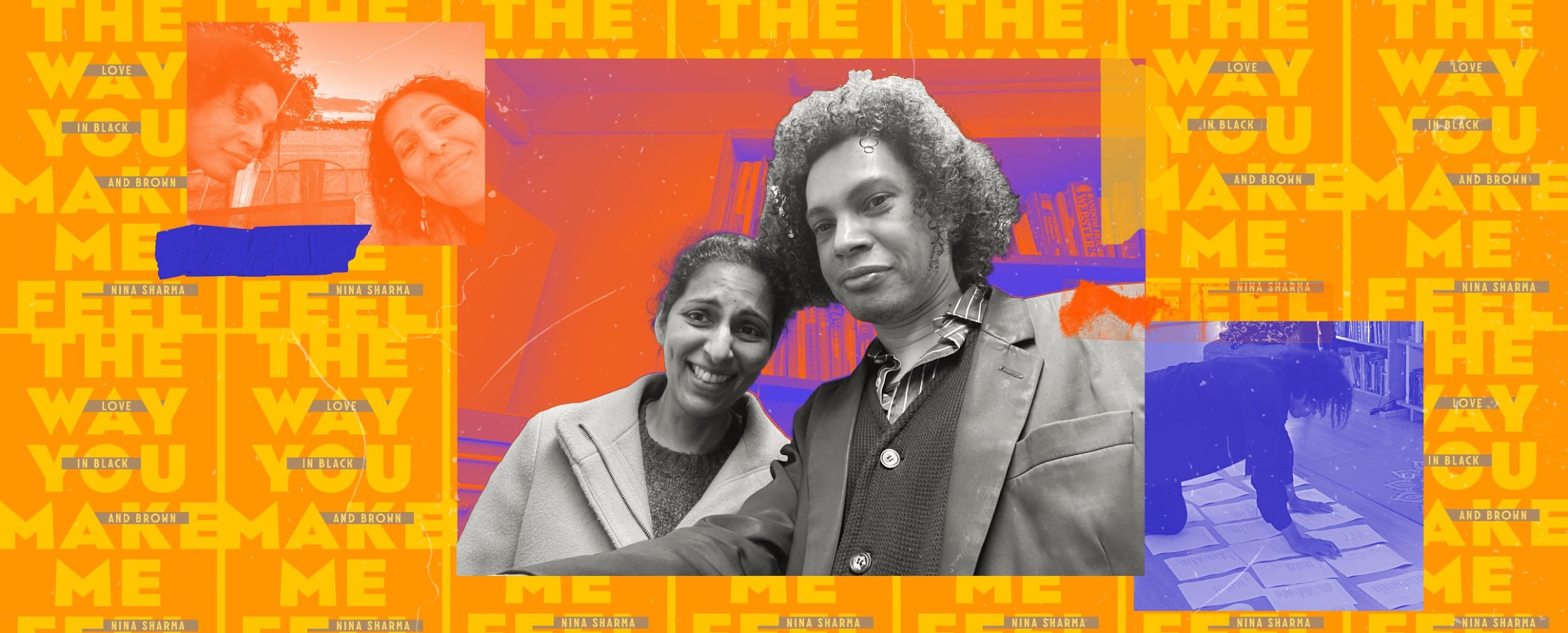
Photos courtesy Nina Sharma; collage by Yunuen Bonaparte
Fifteen years ago tomorrow on what they now call their meetaversary, writers Nina Sharma and Quincy Scott Jones met on their way to a Fourth of July party. More specifically, Nina was visiting their mutual friend in Philly and Quincy was their ride. Their bond was pretty immediate, the stuff of writerly dreams. Nina, a writer, teacher and comedian, was struck by a book she saw in the backseat of poet and professor Quincy’s car. What soon followed was their courtship and eventually their marriage. Their interracial relationship — Nina is Indian and Quincy is Black — is at the center of Nina’s first essay collection, The Way You Make Me Feel: Love in Black and Brown, which came out in May. Though the book consists of Nina’s voice and stories, Quincy plays such a major role that Nina had to figure out a way to write about him as honestly as she was writing about herself — and they both had to grapple with how they come across on the page.
Also at the heart of their story, both visibly and behind the scenes, is the ways in which they collaborate. They have worked together on all sorts of things, from creating Blackshop, a column about allyship between BIPOC people, to the Nor’easter Exchange, a multicultural reading series dedicated to bringing diverse writers together. Nina’s presence is felt in Quincy’s work, as well (you’ll see). He is the author of two books of poetry, The T-Bone Series and How to Kill Yourself Instead of Your Children, and is currently working on a graphic narrative called Black Nerd about two college students at a fictional school set in the early ’90s. I’ve always been fascinated by couples making art together — how it works, why it works, when it’s hard and where the magic lies. I had the opportunity to speak to Nina and Quincy about their work together and apart, and to ask them questions like these and more.
Jesse: Starting at the beginning, I love your meet-cute. You first met through your mutual friend and as soon as you got into Quincy’s car, you spied one of your favorite books, Maxine Hong Kingston’s The Woman Warrior. What were you thinking when you saw that?
Nina: It was that thing of, “What is this man doing with this radical feminist book in his car?” I wanted to know that story.
My editor and I worked on pulling in our relationship as fully as possible because I had become really comfortable writing about myself, but I was still very protective of bringing Quincy into the book. And my editor noticed that. So I started — this was actually Quincy’s idea — to think of us as characters. Quincy’s idea was to call us Harry and Sally, like from When Harry Met Sally, and I used that filter to start flushing out our whole story, him as much as me. As I was working on it and really starting to hit the sweet spot, my editor called it when Harry and Sally fell away and Nina and Quincy came in.
Jesse: Quincy, you had this great idea that was helpful to Nina’s process — how involved were you while she was working on her book, and how involved are you in each other’s writing in general?
Quincy: I got to read everything ahead of time, and that’s a personality choice — Nina likes to share a work in progress. She’s a memoirist and I’m a poet, but we both took classes when we were in grad school that focused on narrative, so there was a lot of, what’s the narrative arc and how is the character being presented? I think just having another writer to bounce things off of is helpful.
Nina: We have a shared craft language. Quincy, you took this comic book class when you were at Sarah Lawrence…
Quincy: Yeah, I had a chance to work with Scott Snyder, and he was the first one who really broke down for me a formula for narrative. This was my second master’s degree so I had a lot of training in poetry, but this was the first time I was like, “Oh, this is how narrative works!” So I would ask these questions of Nina, sometimes ad nauseam, like, what’s the structure, what story is being told?
Nina: The words are now triggering to me [laughs]. I feel like that’s a cool thing that we have, though, this shared way of thinking about a story so we can come to each other with those terms in mind to help each other out.
Jesse: At what point did the Harry and Sally pseudonyms fall away?
Nina: I think midway through. For a long time, I was like, “Did I get it, did I get it, am I there [laughs]?” I think I felt it at different times, but somewhere between “Jersey Jahru,” “Sacrifice” and “Mad Marriage,” that’s where I felt it fall away. But I remember feeling like, “Am I past the deadline for figuring this out?” I went almost down to the wire and then it was very magical when it happened. To any writer out there, I always say you just chip away and give yourself grace as you’re going through it.
Jesse: Had either of you imagined yourselves dating another writer before? When you met, were you like, “Oh no, I can’t date another writer?”
Quincy: We hung around other artists so when I found out Nina was a writer, it made sense. I know I tried your usual “writing flirtation” moves on you when we first got together, but I think we were mostly just two people talking and having coffee and taking long walks in the city.
Nina: That’s so true. Some of the writing stuff fell away and it really was just friendship stuff, flirtation stuff. We also ended up having all these other things in common, being minority kids in suburban New Jersey, being BIPOC kids in these PWIs.
Quincy: There’s one cool story. When we met, I was in my early 30s and as a poet, I had published my first book, but as many poets do, I was looking for that second genre because you want to actually get paid for your writing. And I was telling Nina — this is on our third or fourth date — I’m thinking about going into comics, but I’m not quite sure, and she challenged me to come up with a comic idea on the spot, and that pushed me into my second writing career.
Jesse: Is that what Black Nerd is?
Quincy: Yeah, it’s taking a while, but that’s the project and that came from Neens. That came from her saying, “You can do it!” When you find someone who encourages you to write your silliest story, that’s so great. This is also a testament to how long things take. When I tell people I’m working on this thing that this girl gave me the idea for on a third date and now she’s my wife… Ideas take a while [laughs].
Jesse: A hundred percent. I feel like everything I’m working on I’ve been working on for 10 or 20 years.
Nina: Yeah, people don’t understand that’s a fair amount of time, if not a short amount of time when it comes to writing [laughs]! For me, it’s been such a wonderful thing to have. I don’t know if I had that, such a big writing support system, before Quincy and just having that, it can make all the difference in your writing life.
Jesse: I always loved reading about Joan Didion and her husband, John Gregory Dunne, and the way they would work in the same office together. How do you physically work together? Do you work in the same office or do you have your own spaces?
Nina: I need a lot of quiet, so I’m the one in the office and usually it’s an intense silence in there, maybe too much, so he’s great about fishing me out of there…
Quincy: We do like our space. And Nina is more of a morning writer and I’m a night writer, so, I’ll end up writing at 2 in the morning and she’ll write at 6. As much as we do spend separate time writing, we had this wonderful tradition during the process of Nina writing this book — we’d take a walk at 6, 7 at night, the heat would break and the sun would go down and she’d have a popsicle and then I’d make dinner when we got home and we’d eat late. I was starting my day and she was ending her day, so we always had this moment when our days would intersect, which was really nice.
Nina: It’s like your writing life is this one shared project and I take the morning and afternoon shift and he takes the night shift.
Jesse: Quincy, you moved from Philly to New York where Nina was living, and when you got there, you were both applying to grad schools at the same time. Before you got into Sarah Lawrence, Nina was already starting to get into schools, but you hadn’t yet. I imagine that would be hard. How did you deal with that as a couple?
Nina: That was an intense period. That was “The Joke Limit” essay. It was a tough essay, I feel like I’m a tough character. We had different relationships with grad school. I always felt gung-ho, like it was amazing for me to continue to grow my writing ecosystem from it, not having been there before. But Quincy had already been to grad school and was more into teaching and having a working writer’s life. So school meant something different to you, right?
Quincy: Yeah, it was a little bit of having to restart my career. I loved Sarah Lawrence, loved the teachers there. I made the kind of friendships there where I’ve got a friend who’s second novella just published and I’m proud like it’s my own. But a lot of it was, I had built this writing and teaching life in Philly, which had come to a ceiling, but it was scary to restart. Nina always says she comes off hard in that essay, but I think that’s the essay where I come off a little bit like I didn’t know what I was doing.
Nina: I feel like I’m a jerk in that essay, but sometimes you need to be a jerk in your own book, I think.
Jesse: You definitely weren’t shy about showing moments when you two bickered, which I loved because that can be so hard to do. But it’s also clear you work well together. You’ve collaborated on the column, the reading series, you wrote an article together for Harper’s Bazaar. Is there friction working together, or is it mostly pretty smooth?
Nina: Those collaborations come about organically, like one person brings it to the other and you start to dream things up together…
Quincy: I often use the metaphor that one of us is the gas and one of us is the brake at any time. You don’t want to break too much, but at the same time you don’t want to hit too much gas. I think Nina has an energy in the getup that I lack. The first reading series we did, it was an idea we talked about and then I went to sleep for the night. I woke up and Nina’s on the phone already making connections.
Nina: I think it comes from nonprofit culture. Working at the Asian American Writers’ Workshop, you’re like, “OK, I need to do this, it needs to be done in two minutes,” so you are constantly going. I think I always had that muscle.
For me, the word imagination comes to mind. Quincy, I think you’re really good at making sure we take some time to sit in our ideas and to really let them go into corners where I might be afraid to go, to dare to see past any kind of blind spots to get to a more interesting and transcendent place. That’s what our collaboration is about — having the conversation reach that point in some way.
Jesse: You’re two different kinds of writers, a poet and a memoirist, with pretty different sensibilities, it sounds like. Do you think that helps your ability to collaborate so nicely together?
Quincy: I definitely think so. People have asked if I’ve felt competitive with my wife, and I say no, but that’s probably because we’re two different genres. Every now and then she writes a really good poem and I’m just like ugh [laughs]! I think it is complimentary. Nina opened my eyes up to how close creative nonfiction is to poetry. I thought prose is prose, so fiction and nonfiction go together, but she made me see there’s a poetry in the how — how you tell it is really the fun of the story.
Nina: It is incredible to have a poet as your editor. It’s really a superpower to your writing. It’s very interesting to see the way that he as a poet looks at my words. I feel like he can see it for rhythm, for sound.
Remember when I told my first You Are Not Alone story? It was the first comedic storytelling piece I did, and I was telling Quincy the story of being in a mental hospital when we were making our bed one night. I was stuffing pillows and just telling the story off the top of my head and he stopped me and was like, “Tell the story like that.” And I’d never thought of it that way. It was one of the biggest creative breakthroughs I’ve made. This big story came out of me in this not-forcing-the-funny-but-fun way and ever since then, it has become this practice for me. It’s now a household phrase, “What’s the fun of the story?” I often think there’s just this fun little banter in our household and that’s part of our flirty closeness still after all these years. I want that to be my relationship with the reader too, so where we are, I try to get that on the page.
Jesse: Your book is about the tension and the beauty of being in a Black and Asian relationship, and there were so many unexpected twists, like your parents, Nina, showing disappointment in your relationship, even despite the racism that they experienced, which I found really interesting. Does your interracial relationship affect your writing or how you collaborate in unexpected ways?
Nina: In this case, it became the material for the book. It deeply informed the arc of everything there, both the content and the structure. I think of this book as through Quincy and I, our Afro-Asian relationship, and I want to have a broader conversation about allyship. I think about allyship as something that is ongoing, something that is necessarily imperfect, because any time you try to get something right or wrong, you’re dead in the water. And I think really being OK with being vulnerable and having ups and downs in allyship is what makes you commit to it in an enduring way. So, that’s what I hope is communicated between our relationship, between seeing the growth of where my parents were at the start of our relationship to where they are by the end.
If I think about how our Afro-Asian identity affects my craft, I do think that for me writing, and revision especially, is a solidarity practice. As I wrote and revised this book, I really thought about our Afro-Asian communities, what it means to speak to our communities and the choices I wanted to make. Sometimes that meant centering this type of research or this type of personal narrative. I revised thinking about how I wanted to prioritize an Afro-Asian audience, how I wanted them to feel seen and heard in this work.
And that meant for me that my Afro-Asian solidarity wasn’t perfect when I got to writing the book. I hadn’t graduated from solidarity university, I was still working through it — and still am — as I worked on the book, so I had to interrogate my own blind spots and my own biases even. Revision isn’t just “Show, don’t tell.” Revision in its most beautiful act can be a solidarity practice, it can be a time where you ask yourself, “What are my biases, how can I move past them to have the most liberatory text as possible?” And that’s what I did. I called in my community to give me notes, and ultimately, the feedback I got, I did it not just to react to notes, but ultimately to make a book that felt most like me. In having committed to solidarity, at the end, I was like, “This book is finally like me,” and that was a very exciting feeling to have.
Jesse: We talked about this a little bit organically, but what are you both working on now or next?
Nina: I am starting to think about another book and a lot of it comes out of my comedic storytelling. I have this archive of stuff I say, so I’m thinking about how to put it on the page.
Quincy: I’ve got some things coming out which I can’t quite talk about yet, but I’m still writing poetry, working on a third book manuscript and Black Nerd is slowly but steadily creeping together.
Jesse: Can’t wait to read it all — keep us posted!
This interview has been edited and condensed for clarity.
Jesse Sposato is Narratively’s executive editor. She also writes about social issues, feminism, health, friendship and culture for a variety of outlets.
Yunuen Bonaparte is a photo editor based in Brooklyn. She’s been part of the Narratively family since 2017.